
Finally, the Sun
part iii: a journey through the Canadian hinterlands to the solar eclipse

We woke up later than planned. Our basement suite had skinny horizontal windows, so rising was drawn out and painful. A. and I were adrift in the king-sized bed we were sharing. To feel the nearest person’s warmth, we had to hungrily grope at the covers.
One of the main conversation topics when planning our trip? Clouds. Given the path of the eclipse was from Texas to Maine, we needed to find a place that was close enough for us to road trip to in a long weekend, but that would also have visibility in early April. Our options were limited. We settled on Niagara despite Redditors expressing skepticism at the odds of the skies being clear enough on April 9th.
The weather had been perfect so far. But as we swam through the depths of the basement that Monday morning, it was soon clear that it wasn’t the windows making the bedroom so dark. There was a sheet of clouds across the sky like a lint trap after a load of towels. The sun was nowhere to be seen.
“What time is the eclipse again?” I asked casually, trying to keep my tone neutral.
“Right around 3:15” A. replied, doing the same. We were all a bit quiet. No one wanted to suggest the possibility, even though the signs were pointing towards it. We all kind of just looked at our phones.
“Okay, I guess we should get going so we can grab Tim Hortons on the way.”
We chose Port Colborne, a town on Lake Erie about 40 minutes away from our AirBnB. Per Reddit, going anywhere near the Falls would be a shitshow, especially on the way out. So we headed in the opposite direction. It felt key to be near water. But the drive to the town Port Colborne reaffirmed our unspoken suspicions: it was grey from highway to sky in any direction you looked. The lack of defined place apparent in our surroundings exploited this greyness; all we could see were hills and fields and half-constructed formations whose intentions I could not decipher. Every so often, a warehouse or tractor rose up and fell away. The car also got quieter after we realized we had ordered the wrong number of maple glazed donuts.
As we crossed Port Colborne’s threshold, though, the sun, like magic, tore a hole through the clouds. The town was picturesque, with cute little houses and a beautiful park on the lake. People were already setting up. We drove along the channel and parked next to one of the few businesses in the area, a local coffee shop. It could have been the setting for a Canadian Gilmore Girls or Ted Lasso, something unnervingly cheery and upbeat. The metallic bridge, the white and yellow riverboat, the royal blue guardrail and benches; they all seemed more saturated than anywhere we’d driven through. It was like the film for this place was painted in technicolor.
What most people don’t realize is how hard it is to take a selfie in eclipse glasses. The lenses are, of course, almost completely opaque, which is great for looking at the sun, but awful for coordinating 3 people to look at the front-facing camera at the same time. We added a filter before posting them.
“My eyes still hurt,” K. said, removing her glasses and squinting.
“Same,” I agreed. A strip of fear unraveled in my abdomen. Would we somehow go blind from this? I kept thinking about how embarrassing it would be to get a blind spot from staring at the sun, and how even more embarrassing it would be to explain this to a doctor. What if something in the glasses malfunctioned? It seemed strange that a piece of cardboard with some plastic was the only thing separating my eyes from the sun’s might. Shouldn’t we be taking this more seriously?
By the time we returned to the park, numerous townies were camped out on lawn chairs and the gravel section had been turned into an impromptu parking lot. After being directed where to park by a man in an orange vest, we got out of the car on the edge of Lake Erie. It was painstakingly flat, like a stone eroded for years until it was made perfect for skipping. The shore was lined with big gray rocks, which petered out to a shallow soil ledge. Some people were already setting up along its perimeter, so we grabbed our stuff and joined them. We picked some rocks near the water and spread out our blankets, snacks, and extra solar eclipse glasses; 15 to be exact. It was like packing underwear for a trip. Who knew what would happen that would cause you to go through the first 14 pairs so only the extra 15th could save the day?
To the right of us, a family with 3 or 4 young kids was also camped out. The kids amused themselves with, or rather in, the lake, throwing sticks into it and asking to wade in after. Their parents refused. The kids complained and would not sit in one place. The parents watched and tugged arms and shushed. The music of a video game or children’s YouTube channel blared out the entire time. It struck me that it must be so difficult to be a parent during a cosmic event; as a child, I distinctly remember the boredom I felt at a lot of the things my parents took my brother and I to, things that I now look back on fondly or with a deeper understanding. But when you’re a kid, an eclipse can be kind of…meh? I think most parents are aware of this, too, and take their kids nonetheless.
Lying against the hill behind us was an older man with his camera. He did not amuse himself with his phone, he just looked between the sky, the lake, and his viewfinder and waited for it to begin. I couldn’t help but wonder how old he was, and if he also had thought about how old he was, and what the odds were that another eclipse would put him in the path of totality during this lifetime. Had he seen an eclipse before? Many, even? Was he from this area or did he specifically come for this?
An eclipse is a clock. Sure, I looked at this old man and thought about aging and mortality and if he would make it to another one, but it was also true that I didn’t know if we would, either. Whatever we did, wherever or whoever we were, the next eclipse was already in motion before this one began.
“It’s starting!”
We all craned our heads towards the sky, hands straining to fit the generically cut cardboard wings to our ears. I was still worried that the glasses would slip off. In the same way the body yearns for the edge of a cliff, I felt like some alien part of my brain could not resist looking. Like Orpheus turning back for Eurydice, like Lot’s wife turning into a pillar of salt, the delectable sun was an apple whose knowledge would strip something fundamental away from me. So I held onto my glasses, actively pressing their edges into my brow bone to ensure I wouldn’t do anything dumb, all the while making myself look like I could not figure out how to wear them.
It was impossible to see anything though the lenses, let alone the sun. With almost all possible light blocked out, it became a tiny sepia orb. It looked 2D.
We had about more 40 minutes before totality, so we took our glasses off and went back to talking. We passed the time dipping toes into the clear, frigid water of Lake Erie. I had the urge to wade in. Submerging my ankles and pulling up my jeans, I turned back towards A. and K., still close and person-sized. I wondered what they would look like from out at the horizon, however far away that was.
A. taught us how to take pictures of the eclipse with our phones. She pressed the glasses’ lens to the camera and then angled it towards the sky and zoomed in. She was the best at this by far (evidence below):
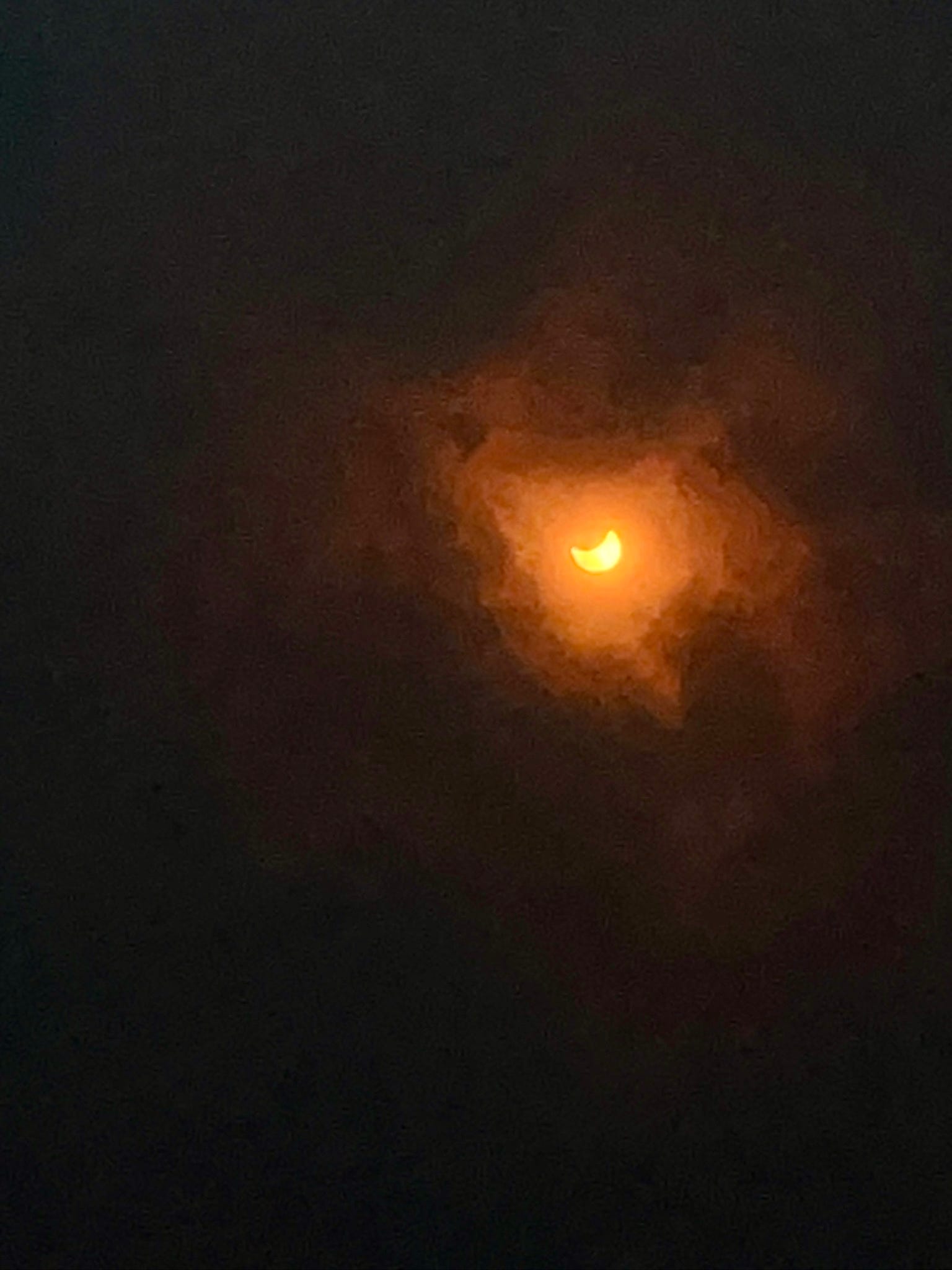
Forty minutes was also long enough for the clouds to come back. We were cued in to this by the commotion around us and hurriedly tried to look for it with our glasses, as if staring earnestly at the sky would make it reappear. No luck. The southern Canadian clouds of early spring had fallen into a familiar posturing. I looked at my phone—about 30 minutes or so. Someone mumbled something about there still being time for them to clear.
Like birds trying to get comfortable on an overcrowded feeder, we shifted anxiously in our seats. More time passed, but the clouds did not.
“Well,” said A, “even if we don’t see it, at least this trip has been so worth it already.” K and I nodded in agreement. The planning, the 5:30 am driving, the calling in sick to work. It had all been worth it. This three and a half minute window was out of our control. If we missed it, we missed it.
“How ‘bout the next one—Spain 2026?”
“It’s happening!”
At first, it was like a big cloud passing over the sun: almost unnoticeable. But the darkness intensified. On the jetty to the left of where we sat, dozens of birds were nested among the tangled woody brambles. The isle erupted in squawking; they were flustered, too. They sensed something was happening. I wondered if they also had a ritual for this.
It got darker. Like everyone around me, I couldn’t resist trying to capture it. I kept taking pictures of the sky. Videos too, panning around to the water, the birds, the people and the sun. Even a selfie. All were failed attempts to trap the nature of the light as it changed. It kept getting darker. My biggest takeaway in the moment was facile: “It kept getting darker.” But really, it did. Every few seconds, I would think we had reached totality and try to document it, and then realize that during my scramble, it had already gotten darker.
Then the light fully went out, for realsies, and everyone broke out into cheers of delight. Like the birds, we were calling out and turning about, trying to figure out what was going on. One of the few lifelong guarantees we have is the sunrise and the sunset. To watch our most consistent association be broken was to break our minds’ defaults, too.
As we oohed and ahhed, I couldn’t help still deeply wishing for a breach in the cloud cover. It was distracting how strongly I wanted it. I had to keep reminding myself to focus on the eclipse.
We stood staring at the sky with this uncertainty, this lack of control ruling our foreheads and the napes of our necks. The seconds hastily snuck away and the sun slowly marched on with heavy footsteps; time’s duality, nonexistence and overarching control. My longing was the strongest it had been in reaction to how pivotal this all felt. We stood still, wishing things would change, feeling powerless, unable to do anything but stand there and observe what actually was. It was okay. It wasn’t what I wanted, but it was okay. The present was so alive we could not do anything but play our parts. Our bodies, the sun and the moon; there was no space for us in their touch.
Then, then, for the briefest of seconds: a flash of the sun covered by the moon: a black circle outlined by a rim of white flames: totality. The crowd erupted into cheers.
“Look, LOOK!” we all cried, pointing and jumping and smiling. Tears rimmed my eyes. And just as quickly, the clouds, covering it up. But we had seen it. We saw totality. We were part of it. We were changed.
The aftermath is the calmest sunrise you will see. As the moon finally lets go of the sun and the hands of the clock snap back into place, the darkness lifts from the world like a body emerging from delta waves into the half-awake state of dreams and dawn. As the sun reasserted its solitary rule, the clouds retreated, and we were bathed in a gentle white light. I do not remember my baptism; I was, of course, a baby. But I imagine if a true baptism were to exist, it would be found in the aftermath of an eclipse. All the intensity built up and then released, through one among many. Like how after a good cry, a heavy warmth settles beneath your bones and skin. The sudden darkness makes the light brighter in comparison. Most people around us left right away, but we stayed on the rocks until the entire eclipse was over, basking in the warm white sunlight, taking in the endlessly still water, and occasionally looking at each other and laughing.
All of us youths, with our skepticism for religion and tradition and anything old or done before. And then, to experience something so human, something that has been tracked for millennia, and have a strange feeling in your chest, and say, “Oh. I’m changed.” The ritual, the community, witnessing something greater than yourself. It is inescapable.
The deep irony: this ultimate break in expectations happened, happens, like clockwork. A routine event interrupting our routines and connecting us. What is around me is determined, fate exists to some degree, and yet it still matters what I do, the choices I make, who I decide to be. The world is constructed and bigger than us all and even in this vastness I still get to choose, even if the choice is just to bear witness to it all.
As the sun locks bodies with the moon, we lock eyes with them both, and our bodies are locked together in an upturned stance. We look and then move on. They return, we look again. There is certainty in the uncertainty; what is faith but steadfastness in the possibility for anything to occur?
Driving around after, the sun’s heat was ineluctable. We were sweating, trying to flee the coming night. As if driving would suspend time and this moment would linger on, and its rebirth would never leave us, and we would live the rest of our lives with fresh hearts and open eyes, everyday a baptism, a birth, a death and a wake. The forward motion, the race with, or against, the sun: that was the thing. The second we stopped, really stopped, that moment would end, and we would be back to our old selves, our enshrined habits and patterns. Same bad jobs and lack of money, same daily disappointment and embarrassments.
Why travel? Why see the total eclipse? Something deeper churns. The moment of the moon surpassing the sun, the lead up to it, the question and the answer. The incomprehensibility of it all, experienced among friends and strangers alike, a community who will never be again. All of this, and the beauty. The sheer beauty.
An eclipse builds a well. It opens a door that was not there before. It is impossible to take the sun’s path and be reborn, then die everyday. But in the weeks and months since? A sense of ease. A fissure to expand through. The totality was gone in minutes. But the shortcut to transcendence remains.
The general malaise many of us feel these days; an inability to connect actions with meaning. For me, the disconnect between all my little efforts and the greater structure of what goes on. A deep, deep lack.
But the planets and stars: they dance to their own time, unmoving, then explode with change.
Like finding a light switch in the dark.
Or laying eyes on someone you know you will love.
Like a window opening in the dead of winter; like saliva swapped during a kiss.
The change is not instant, but as the days press on, you expand: K now in New York with a remote job. A. in a loving relationship. Me in a house and job where I can finally let out my breath.
The world is without meaning and order, and yet, I find both everywhere. I look back at notes on my phone and find that things have come to pass in unexpected ways. The world spins on and we push towards the next meeting; whatever happens, the moon and sun, together again. Nothing I do can change that. But I will measure myself in eclipse time and see what the coming totality changes in me. Retroactive premonition. An hourglass full of stars.
If you made it to the end of this post, thank you from the bottom of my heart. This is the longest piece I’ve published, and it’s taken me months to pull this whole series together. As we enter the last month of December, I am not sure what this blog will look like in 2025 (a 2024 goal was to post at least once a month). My project now favors longer-form and -term pieces, which is hard on this platform. I’m not sure what anything will look like. But it’s all so exciting, isn’t it?
                                                                                                                                           ♡ ♡ ♡
                                                                                                                                             -pash
soundtrack: Cloudbusting by Kate Bush